Audit trail
A record of every material action that cannot be rewritten.
What is logged
Every filing transition, sign-off, content edit, integration sync, and admin action writes to the append-only, hash-chained audit log.
The database refuses updates and deletes on audit rows, and the hash chain is re-verified daily, so any change shows.
That includes TakePublic's own operators. A platform admin who opens your company read-only is recorded as an inspection; one who needs to act for you takes a support seat, at your request, for 60 minutes at most, with the reason written down. The seat's start (reason and expiry) and end (left, or expired) are events in your trail, and every change made from it is under that person's name.
Hash chain
Each event stores the hash of the event before it in your company's own chain; events that belong to no company form a separate platform chain. Hashes are not shown on the audit pages: they are in every CSV export and in the company records copy, where anyone can check that the chain is unbroken.
Browse the audit log in the app
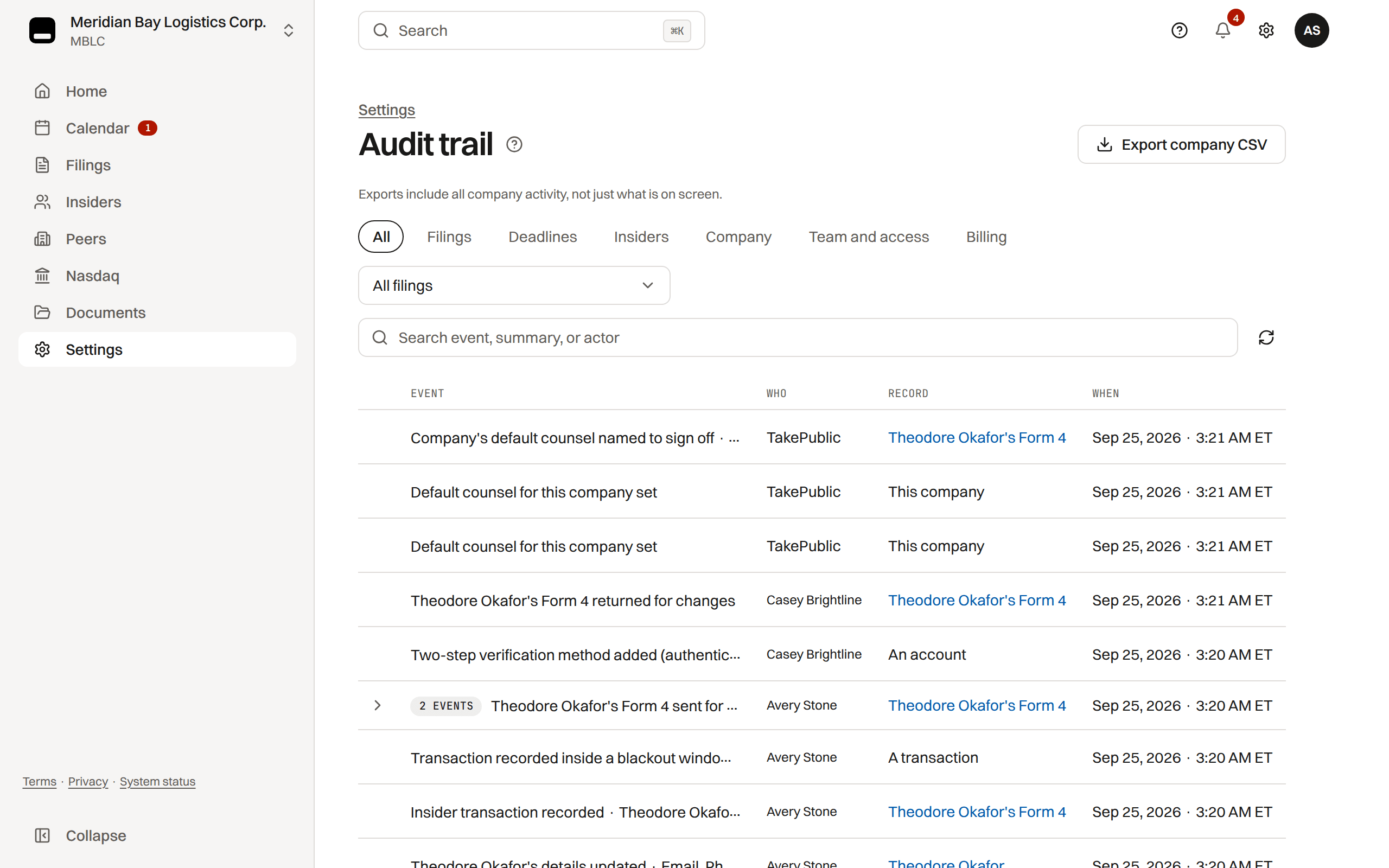
The Audit trail page lists every event for the company with who acted and the time in ET. The pills narrow it by the record an event touched: Filings, Deadlines, Insiders, Company, Team and access (which holds every platform operator event: an inspection, a support seat, a second-factor reset, an import re-queued) and Billing.
Pick a filing in All filings to see every event for it, or search by event, summary or the actor's email. Opening an event shows what happened, who, when, the record it touched and any values changed.
Counsel and preparers read only the events about the company's filings, and a company user whose Works on leaves out an area reads none of that area's filing events.
Export company CSV holds every company event and Export filing CSV every event for the selected filing, whatever the view or search on screen.
More detail
In every CSV TakePublic writes, a cell that begins with =, +, - or @ (a comment that starts with a minus sign, say) is written with a leading apostrophe so a spreadsheet opens it as text and never runs it as a formula; plain numbers are left alone.
Retention
TakePublic keeps signed records, attestations and the audit log for as long as it provides the Service, and in any case for at least seven years after a record is made and, for an attestation, at least seven years after the signer's most recent electronic signature through the Service. They are not deleted when an account, subscription or workspace ends, or in response to a request to delete personal information.
Filing documents sit in versioned storage with soft delete, protected from deletion by a retention policy TakePublic administers. The privacy policy at takepublic.com/legal/privacy states each retention period.
Rule: Rule 302(b) attestation records are kept for as long as the signatory may use the electronic signature and at least seven years after the last document signed with it, the period Regulation S-T Rule 302(b)(2) requires the filer to keep and produce them.
Was this helpful?
Thanks for the feedback.A company admin downloads one zip of the company's records from Settings › Company: a two-step sign-in, three downloads a day, a 15-minute link.
Still need help?
Sign in and open the Help widget in the lower right corner to message the team. Replies land in the app and by email.
TakePublic is a technology platform, not a law firm, broker-dealer, or auditor. Forms 3, 4 and 5 prepared in TakePublic file only after the reviewer the company designates, such as its securities counsel, signs off; any other filing prepared in TakePublic files only after a licensed securities attorney signs off.