How deadlines are computed
Fiscal year end plus filer status drive every due date in Eastern Time.
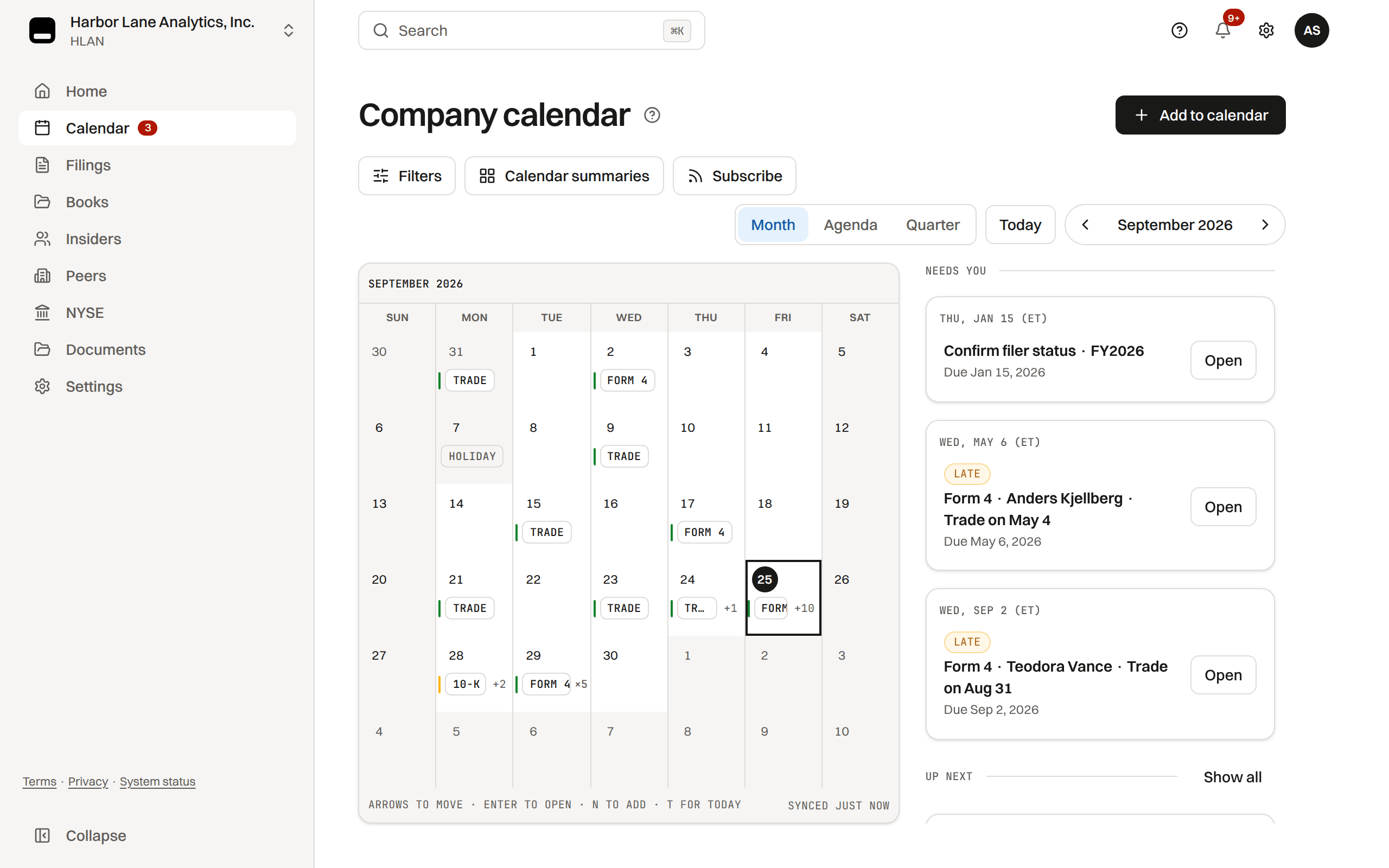
Inputs and rolls
Your fiscal year end and filer status (non-accelerated, accelerated, or large accelerated) set every statutory due date, all in Eastern Time (ET), the clock the SEC uses.
Rule: Form 10-K General Instruction A(2) sets 60, 75 or 90 days after fiscal year end by filer status; Form 10-Q General Instruction A(1) sets 40 or 45 days after quarter end.
- The official form texts (PDF) are on sec.gov under About, Forms.
- A due date that lands on a Saturday, Sunday or federal holiday is met by filing on the next business day (Exchange Act Rule 0-3(a)).
- The Company calendar and the deadline alerts use the rolled date.
Event-driven forms
Event-driven forms run on their own clocks, apart from the 10-K and 10-Q, and roll off weekends and holidays the same way.
- Form 8-K: four business days after the event (Form 8-K General Instruction B.1). An 8-K/A carrying Item 9.01(a) acquired-business financials may follow within 71 calendar days after the initial report's due date (Item 9.01(a)(3)).
- Form 4: before the end of the second business day after the transaction (Rule 16a-3(g)(1)). A transaction exempt under Rule 16b-3, such as a grant or award from the company, is a Form 4 item on the same clock. A Rule 10b5-1 plan trade or a discretionary transaction whose date the insider did not choose runs from the day the broker or plan administrator told them, and no later than the third business day after the trade (Rule 16a-3(g)(2)-(4)); that deemed execution date is the form's Column 2A.
- Form 4 after leaving: a trade after the person stopped being a director or officer is still reported when it falls less than six months from an opposite, non-exempt trade made in office (Rule 16a-2(b)); recording the departure keeps that Form 4 open and ends the others.
- Form 3: 10 calendar days after becoming a director, officer or greater-than-10% holder (Form 3 General Instruction 2(a)); a person who is already an insider on the day the company first registers a class under Section 12 owes it by the registration's effective date (Instruction 2(b)).
- Form 5: 45 calendar days after the company's fiscal year end (Rule 16a-3(f)(1)), for the few transactions the rule defers to it.
- Form D: 15 calendar days after the date of first sale.
- Schedule 13D, or a 13G for a passive investor under the 2024 amended rules: five business days after crossing 5%; a qualified institution or exempt investor files its 13G 45 days after the end of the calendar quarter it crossed in (Rule 13d-1).
Amendments have no statutory deadline of their own: a 10-K/A, 10-Q/A or 8-K/A carries no due date and shows the day you started it, and a Form 3/A, 4/A or 5/A carries the original form's due date. Creating an amendment never creates or satisfies a calendar entry.
Only obligations that apply to you
The calendar is gated on your registration and market tier, so it never nags you about filings you do not owe.
- Companies reporting only under Section 15(d) see no proxy or Section 16 entries.
- Section 12 issuers get Part III proxy and information statement obligations; filing a DEF 14A or DEF 14C satisfies that entry, and a proxy already on EDGAR for the fiscal year satisfies it when your workspace activates.
- Alternative-reporting companies see OTC disclosure deadlines instead of 10-Ks and 10-Qs.
- OTCQX, OTCQB, and OTCID tiers get an annual Management Certification date and an OTCIQ profile verification date every six months. The certification and Pink Limited annual deadlines can generate downloadable OTC documents to post through OTCIQ; the profile is verified in OTCIQ itself and marked done here.
- Section 12 issuers get a year-end Form 5 check, due 45 days after fiscal year end, to confirm insider Form 5 filings or collect each insider's confirmation that none is required.
- A filer status review entry takes public float and optional revenue to suggest accelerated or large accelerated status.
- Deadlines you track yourself carry the Tracked pill and cover work TakePublic does not draft: registration statements with outside counsel, Form 25, and other company-specific obligations.
Checkpoints dated before your workspace existed
The calendar is built from your fiscal year end and filer status, so it also dates the checkpoints of the year you joined in: the filer status review after Q2 and the Form 5 check after year end. One that fell due before the workspace was activated was never anyone's to meet on time here.
Its row shows the date with no day count and is never late; it never counts as missed or against your health score. The same checkpoint on a workspace that existed in time counts its days late.
A company admin confirms it from the row's Confirm panel, prefilled from EDGAR and your roster; your securities counsel can review the answer, but the confirmation is the company's. The row stays until it is confirmed because the answer feeds later deadlines: the filer status sets next year's 10-K and 10-Q due dates, and the Form 5 check records which insiders still owe one.
When your profile changes
Editing the fiscal year end, tier, or registration basis in Settings recomputes the whole calendar. Filer status is determined once a year from the Q2 public float on the filer-status checkpoint (Rule 12b-2); Settings shows it read-only with its source.
Obligations that no longer apply are removed automatically, and everything removed or changed is recorded in the audit trail.
Federal holidays and EDGAR closures
EDGAR does not receive, process or accept filings on federal holidays, and the SEC treats a proclaimed closure (a national day of mourning) the same way. The SEC publishes each year's dates on its EDGAR calendar, the source TakePublic's holiday list follows.
Exchange Act Rule 0-3(a) (17 CFR 240.0-3) sets the roll: a deadline that lands on a Saturday, Sunday or holiday is met by filing on the next business day. The Company calendar shows each holiday with the day EDGAR reopens and lists your own deadlines that day moved, with the date each would have carried had EDGAR been open.
Select the holiday on the month grid and the day card answers in order, one line each: the closure ("Columbus Day · EDGAR is closed", with a (?) that opens this section), the Rule 0-3 sentence, your deadlines the day moved ("Confirm Form 5 filings · was due Feb 15 · now Feb 16", or "None of your deadlines move because of this day.") and the day EDGAR reopens.
The moved rows come from the same deadline math as the rest of the calendar, not from a separate list.
Was this helpful?
Thanks for the feedback.Email from 30 days out through 7 days past due.
Still need help?
Sign in and open the Help widget in the lower right corner to message the team. Replies land in the app and by email.
TakePublic is a technology platform, not a law firm, broker-dealer, or auditor. Forms 3, 4 and 5 prepared in TakePublic file only after the reviewer the company designates, such as its securities counsel, signs off; any other filing prepared in TakePublic files only after a licensed securities attorney signs off.